
Art in the Clubhouse
The Tuesday Musical Club’s clubhouse is the home to several interesting pieces of art related to music and to our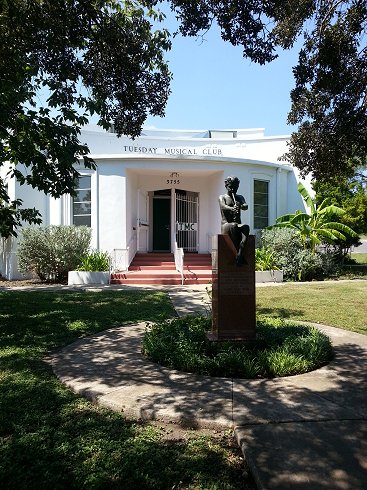 history. The first piece you see even before entering the building is Pompeo Coppini’s “Genius of Music,” displayed in front of the building. The charming statue of Pan playing a flute greets visitors to our clubhouse. It was given to the Club by Harry Hertzberg, son of our founder Anna Hertzberg, when the building was erected in 1950. Waldine Tauch, Coppini’s apprentice and sculpting partner, is named as co-creator of the Pan statue.
Coppini was a famous sculptor whose works are prominent on the Capitol grounds in Austin as well as on the University of Texas campus there. His most famous work in San Antonio is the Alamo Cenotaph.
 At the top of the exterior walls of the building are several lovely cameo busts of famous composers. Unfortunately, we do not have information on who sculpted these busts. Those composers we’ve been able to identify are noted on our website – Beethoven, Bach, Chopin, Mendelssohn, Mozart.
Inside the clubhouse, we find another Coppini sculpture: a bronze bust of composer John M. Steinfeldt, who was born in Germany but who moved to San Antonio in 1887. He was an organist at local churches as well as a composer, and he conducted the TMC Choir.
In addition, he was the conductor when 26 TMC pianists played Beethoven's Fifth Symphony at the Municipal Auditorium, in honor of the centennial of his death. The bust of Mr. Steinfeldt was cast in 1935.


Another bust graces the clubhouse, a likeness of Mrs. Hertzberg herself. This sculpture was fashioned by Coppini’s partner Waldine Tauch. The date of its creation is unknown.
We have two portraits of Mrs. Hertzberg in the Clubhouse as well. One, on the left below, is a photograph of her in her later years, and the other is an oil portrait, dated 1900, the year before she founded our club, and some time after her move from New York to San Antonio. She was 38 when she sat for this picture. We do not know who painted this portrait; internet searches on what we could decipher from the signature on the painting have yielded no answers. But fortunately the date is clear! And we'll continue to do research in our archives and try to solve the mystery of this unknown artist.

Along the ceiling dropdown facing the stage we find several framed prints of operatic scenes. They might have been painted by the muralist William de Leftwich Dodge, and are from a book about opera scenes.

Even our restrooms have lovely art to grace their walls. A particularly charming item is this spotlight on five Club members from the 1920's, who must have gotten together to form a small choral group:

About The San Antonio
|
|

Tuesday Musical Club sponsors three outreach programs for the community |
|
Junior TMCThe Junior Tuesday Musical Club gives young people in grades 1 - 12 an appreciation of the beauty of music and an opportunity to perform for each other on a professional stage. The Juniors' annual competition takes place each February winners perform at the TMC meeting in March. |
Young Artists CompetitionSince 1956, a Young Artists Competition has been held each spring for serious students of music who reside or study in Texas, with $10,000+ in cash prizes. The competition rotates among three disciplines: piano, voice, and strings. The next competition, for strings, will be held March 7, 2026. |
 Free Programs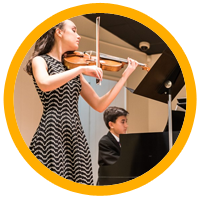

|
